NEWS
|
When Refrigerator Market stalls: Technology Flowers Game to Keep Fresh "Real Kung Fu"Statistics from the National Bureau of Statistics show that by 2017, the number of refrigerators in 100 households in China has reached 97. After the incremental space touches the ceiling, how to pry open consumers'enthusiasm for new upgrade and open up new space has become the "new normal" in front of the industry. New Normal of Game Preservation Under the new normal situation, the game of refrigerators market in China has shifted from competing price, competing marketing to competing strength. Some household appliances analysts compared the Japanese market, from about 10 years ago, the Japanese refrigerator market entered a saturated state, and then its annual sales volume remained around 430-45 million units, with little interannual fluctuation. Today, China's refrigerator market has entered a similar "steady state". Industry online data show that domestic refrigerator sales reached a peak of 56 million units in 2012, followed by a three-year call-back period. Starting from 2016, the industry began to fluctuate slightly around 45 million units, with domestic sales of 47.31 million units in 2016, 44.8 million units in 2017 and 45 million units in 2018. Contrasting with Japan's industrial path, the industrial competition logic began to return to the core needs of users after the basic needs of family refrigeration were met. In view of the fact that the technological evolution of compressor and refrigerant, which is the core of refrigerator industry, is a slow process, the concept of "subversiveness" has not yet appeared in the industry. At present, we all owe different ways to the improvement of refrigerators'freshness-keeping performance. However, the propaganda about preservation is dazzling, such as ion preservation, VC preservation, oxygen control preservation, microcrystalline preservation, zero degree preservation and so on, which often confuse consumers. Thus, the most frequently asked question by consumers is: "Which is the best preservation technology?" And the Purchasing Guide is naturally "Wang Po sells melons", one after another boasts of their own good. According to Wang Haiyan, a pre-research engineer of Haixin Refrigerator, refrigeration preservation is often a combination of various technologies. She said that refrigerator preservation technology is a process of extending the shelf life of food by using physical and chemical methods such as low temperature, air isolation, and increasing antioxidants. "Food spoilage is mainly attacked by microorganisms and their own enzymatic activities, which lead to nutrient decomposition and decay. Especially in cold-blooded animals such as fish, enzymes play a strong catalytic role. Infected microorganisms will accelerate their deterioration. The function of refrigerators is to delay the storage time according to the characteristics of food spoilage. Long." Wang Haiyan categorized the current mainstream preservation techniques. Include: Zero-degree preservation, that is, the use of precise temperature control technology, so that the room temperature infinitely close to 0 degrees Celsius to store food. "0 is a magical critical point. When the temperature is infinitely close to 0 but not less than 0 C, it can ensure that food does not freeze and can inhibit microbial reproduction and nutrient loss, so it is more suitable for the preservation of perishable foods such as fresh meat, fish, fruits and vegetables." Around 2011, Boxi household appliances first introduced the concept of "zero degree preservation". Then the industry followed up and evolved the concept of "variable temperature warehouse" of refrigerators. However, according to senior personnel of Boxi household appliances research and development, the essence of zero-degree preservation lies in "infinite proximity". Only a few enterprises such as Boxi household appliances can accurately control the temperature difference between (+0.1). Many others advocate that the temperature change of "variable greenhouse" is between (+1~2). The ability of temperature control alone can test production. Whether the product is high-end or not and the "real effort" of the enterprise's bottom technology design. Vacuum preservation, that is, the use of vacuum pumps to extract air from containers, food closed in a certain space, creating a low-pressure, hypoxic environment. By inhibiting the oxidation reaction and the growth of microorganisms, the purpose of preserving fresh food can be achieved, at the same time, moisture-proof and mildew-proof can be achieved. Haier and other brands promote dry and wet storage is to use this principle to achieve the storage of tea, Shanzhen and other dry goods.
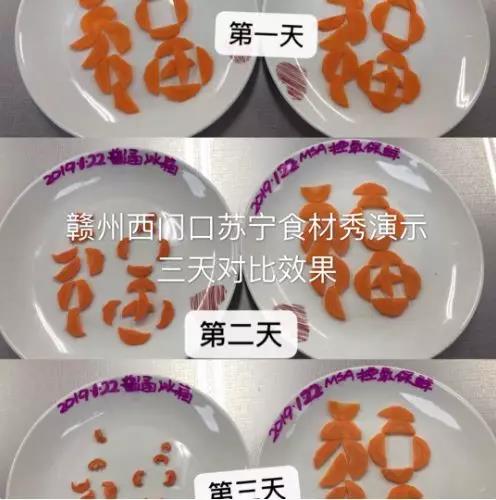
Also prolonged by inhibiting the oxidation reaction of food is the oxygen-controlled preservation technology of Casadian MSA. At the AWE 2019 exhibition, Cassati displayed a number of products carrying the technology, with a starting price range of more than 15,000 yuan. Oxygen control technology can prolong the fresh-keeping time of food materials by about 8 times. Some users of Little Red Book shared the contrast of fresh carrot slices between ordinary refrigerators and oxygen-controlled refrigerators (as shown in the figure), and the visual effect was more impact. Haier technicians told China National Grid that the core of oxygen control and fresh-keeping lies in carrying oxygen-enriched membrane, which can control the permeation rate of oxygen and nitrogen, thus adjusting the ratio of two gases in storage room and delaying cell metabolism. "This technology is not only Haier's original, but also the embodiment of Haier's wisdom of"group innovation". There are dozens of ways to adjust the ratio of nitrogen to oxygen, but few of them can be used in refrigerators. Through the"advice"of users of HOPE platform, we chose oxygen-enriched membrane. More popular is electrostatic field freshness preservation, which uses high-voltage static electricity to generate special electromagnetic electrostatic waves, resonance with water molecules in food to activate them, while providing space electronic energy, using redox reaction to reduce the loss of nutrients, to achieve the effect of prolonging food freshness preservation. Japanese brand Panasonic, Sharp, domestic brand Rongsheng, Didu, Mitsubishi and so on have used electrostatic field as the main push technology, such as various nano-ions, water ions and so on. In the second half of 2018, platinum clean air technology returned to the consumer horizon. Skyworth and others have focused on promoting the technology around 2013, but it has not caused much market reaction. In 2018, Bosch household appliances pushed new refrigerators with platinum air purification system, which received good response, probably related to the upgrading of the consumer environment. The core of platinum clean air is to use Perkin ion and silver ion to cooperate and achieve the effect of sterilization and purification of space by circulating filtration of air in refrigerator. Consumers mostly have this experience, once the refrigerator has placed food, no matter how clean, taste, or even open for several months, there is a lingering smell. The platinum clean air can effectively purify the storage space, avoid the residual taste, to a certain extent, solve the user's pain point for "odor". In 2019, TCL launched high-end new products priced at more than 20,000 yuan. Its main technology, Blue Point Warehouse, is to use physical metal materials to rapidly reduce the temperature of meat and other food materials to achieve quick-freezing and fresh-keeping. This technology originates from ocean fishing boats. Quick-frozen preservation is also a major classification of preservation technology. It uses heat transfer enhancement and freezing speed acceleration to make meat pass through the ice crystal formation zone at 0-5 C quickly, forming smaller ice crystals and avoiding cell membrane damage. The faster the freezing rate, the smaller the ice crystals formed in cells and the less nutrient loss after thawing, the better the color and viscoelasticity of meat can be maintained, and the juice loss rate can be reduced. Another technology originated from ocean-going fishing vessels, namely ice-temperature preservation, which dates back to the 1970s and was first applied in Japanese refrigerators. In 2019, based on the acquisition of Toshiba Baidian, MeiMei launched a "one-week-fresh microcrystalline" product. The so-called ice-temperature preservation is that food is stored in the freezing temperature range from 0 C to food. Being in the ice-temperature zone can not freeze food tissue and cells, and the cell structure can not be destroyed, which is equivalent to entering "dormancy", thus reducing cell metabolism and minimizing energy consumption. From application technology to underlying technology In recent years, in the field of refrigerators, Chinese enterprises are turning their attention from practical application to underlying technology research. Some home appliances analysts told China State Grid that once China's white electricity industry was just a follower. Since OEMs can make huge profits, in many technologies, just follow the footprints of predecessors. However, with the establishment of the industry's goal from big to strong, we can't take others as teachers in original and subversive technology. The necessary basic and bottom-level research is a lesson that the industry urgently needs to make up. For example, from 2018 to 2019, China's refrigerator industry set off a "thin" storm, that is, the use of vacuum insulation board instead of traditional polyurethane foaming agent. Xie Zhenggang, director of Fujian Saite New Material Research and Development Department, said that by combining vacuum insulation with microporous insulation, its insulation performance can reach 10 times that of the traditional insulation material of the same thickness, thus becoming the most advanced and efficient insulation material currently used in refrigeration and refrigeration equipment. At Mitsubishi's "all-round thin" refrigerator conference in 2019, China State Grid reporters personally witnessed the contrast between the slab wall cut at the scene and the traditional one, roughly estimating that the slab wall is only about half the thickness of the traditional one. Under the same volume, thin refrigerators not only have larger internal volume, but also have been optimized in structure, basically realizing the "wall-mounted" placement and releasing the home space. Xie Zhengang said that HCFCs, an ozone-destroying substance, is needed in the production of traditional refrigeration foaming agents. The product has been phased out internationally. Vacuum insulation board will become the mainstream insulation material in the refrigerator industry in the future. Vacuum insulation board has been widely used in Japanese refrigerators, but it was not until 2018 that domestic enterprises began to try to use this material, including cost factors, technology and patent elbows. In 2014, Panasonic Electric filed a civil lawsuit with the court, which started a three-year patent offensive on whether the vacuum insulation board produced by Set New Material was a patent infringement. The lawsuit lasted three years until 2016, when the court decided that Set New Material won the lawsuit. In a sense, this victory laid the foundation for large-scale replacement of vacuum insulation board in domestic refrigerator industry. Similar examples are not uncommon in refrigerators and other categories. In the interval of an environmental refrigerant substitution meeting, Jiang Feng, chairman of the China Home Appliances Association, said: The reason why we make every effort to make our own environmental refrigerants is to prevent foreign patent giants from choking their necks and controlling the "blood" of our industry. Including Zhang Ruimin of Haier, Fang Hongbo of Mei, etc., more than once conveyed to the industry the enthusiasm to do basic technology, core technology and forward-looking technology. In 2018, Mei Group realized a net profit of 20.2 billion yuan, and its R&D investment was reported to be 1.8 billion yuan, or about 12.4 billion yuan. By 2018, Mei's refrigerator business department had established 96 research rooms, including 14 national-level ones. In addition, Mei's Institute of Central Research had laid out its prospective technology for the next 3-5 years. In 2018, Qingdao Haier realized a net profit of 7.44 billion yuan, and its R&D investment was 5.081 billion yuan. By 2018, Haier had formed 10 R&D centers in the world, each of which had a R&D headquarters to explore original technology. At the same time, it established a global advanced R&D center to advance the prospective technology by at least 2 billion yuan. Year's reserve. In November 2018, Haier Refrigerator boarded CCTV's "Challenge Impossibility" platform to show the fresh-keeping effect of "Strawberry slices stored for 7 days, fresh as first picked strawberries", which is called "cell-level fresh-keeping". In fact, at this stage, it is not only how to achieve more accurate refrigeration temperature, but also involves the intersection of nutrition, biology, microelectronic control and other comprehensive disciplines. Behind "dazzling technology" is the support of the comprehensive strength of enterprises. In the plan of the road map of refrigerator technology in China in 2015, the target of 25% increase in energy efficiency of household refrigerators by 2020 compared with that in 2015, and 5% increase in refrigeration power of fixed frequency compressor by 2020 compared with that in 2015, and the target of 30% use of variable frequency compressor are set. In addition, the roadmap has made plans for low-carbon environmental protection, the growth of large-volume refrigerators, product reliability and intellectualization. So far, these goals have been gradually achieved. In October 2019, the China Home Appliances Association is expected to release a new version of the roadmap to establish the technical development goals of the industry from 2020 to 2025, this time. The development goal of national refrigerator industry is to catch up and lead. |